> For the complete documentation index, see [llms.txt](https://userguide.deepq.ai/llms.txt). Markdown versions of documentation pages are available by appending `.md` to page URLs; this page is available as [Markdown](https://userguide.deepq.ai/use-cases/train-test-ai-model/advanced-tips.md).
# Advanced Tips
## Dicom Specialized Training (SSDL)
#### Smart Scan Deep Learning (SSDL)
Smart Scan Deep Learning (SSDL) is a advanced technique that can optimize the training results of Dicom images. SSDL will automatically activate when Dicom format in the dataset are detected.
#### Prevent Data Leakage
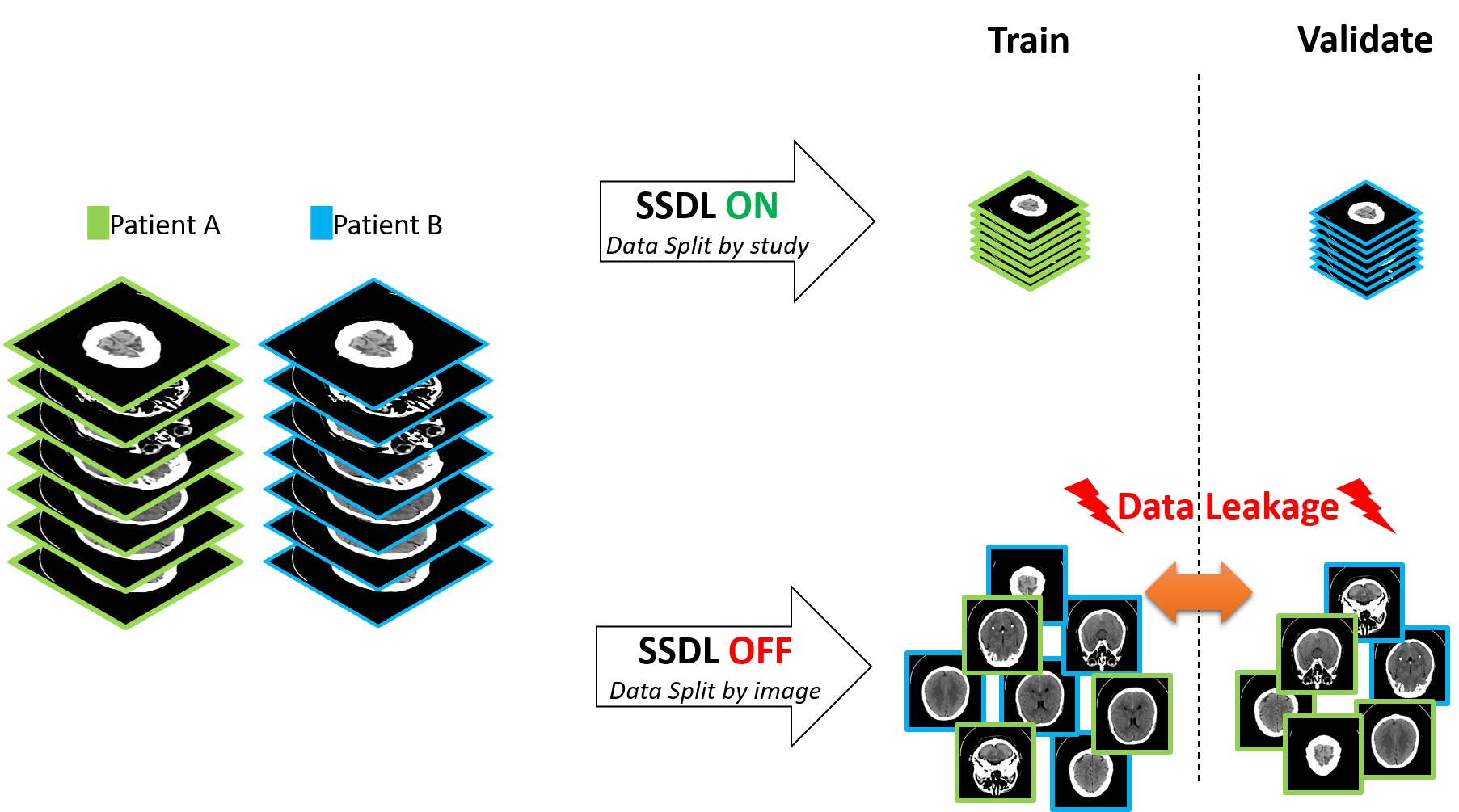
Data Leakage during training happens when the train/validate split is not handled carefully, causing some of the validation data contains information from the training data. As a result the validation score might overperform and be misleading.
In medical scans with image series, information might be shared between slices in a single scan. Therefore, splitting data by study prevents data leakage, as shown in the figure below.
SSDL prevents data leakage in sequential images through "split by study"
#### Activating SSDL
When the user selects a dataset in training tasks, the system will detect whether the dataset contains sequential information and activate SSDL automatically.
## AI Assisted Annotation
An algorithm trained to classify Chest X-ray images cannot help in segmenting tumors in brain MRI since each Deep learning algorithm is task-oriented. AI assisted annotation must start with an neural network trained specifically for the same purpose.

#### AI Training
* Create an prediction only batch inference.
* Select the dataset from the inference list, and click on the "EXPORT TO ANNOTATE" tab to start the AI assisted annotation task.

* Name the annotation data that you want to export.

* The column below shows the dataset details, where you can make sure if you have select the right one.

#### DeepCap
* Back to DeepCap, and create an annotation project.
* Select the dataset from the drop list, enable the option "Include annotation data", and choose the one that have been annotated by AI.